Snap Inc. Case Study · Learning Design

How do you teach the next generation of designers when emerging technology changes every day?

I helped design and coach the learning experience for the Snap Lens Academy, a nine-week program that takes beginners and turns them into intermediate AR creators. I worked on the 2023 and 2025 cohorts, plus Snap's self-paced AR curriculum and the UK Lens Challenge. This work was done as a contractor under Next Shift Learning, who has partnered with Snap on this program for over five years. Snap provides the opportunity, the experts, and the platform. NSL designs and operates the learning experience. I was the learning design practitioner on the AR side.


The Program

Where art meets technology.

The Snap Lens Academy is part of Snap Academies, Snap Inc.'s initiative to create pathways into tech for underrepresented talent. There are four academies (Design, Engineering, Storytelling, and Lens), each targeting community college students, recent transfers, and Opportunity Youth who face real barriers to entering the industry.

The Lens Academy focuses on augmented reality. Over nine weeks, scholars learn to create 2D and 3D AR experiences using Snap's Lens Studio. It's a technical skill set that sits at the intersection of art, code, and spatial design. It's the kind of creative career path that didn't exist ten years ago, taught to people the industry has historically overlooked.

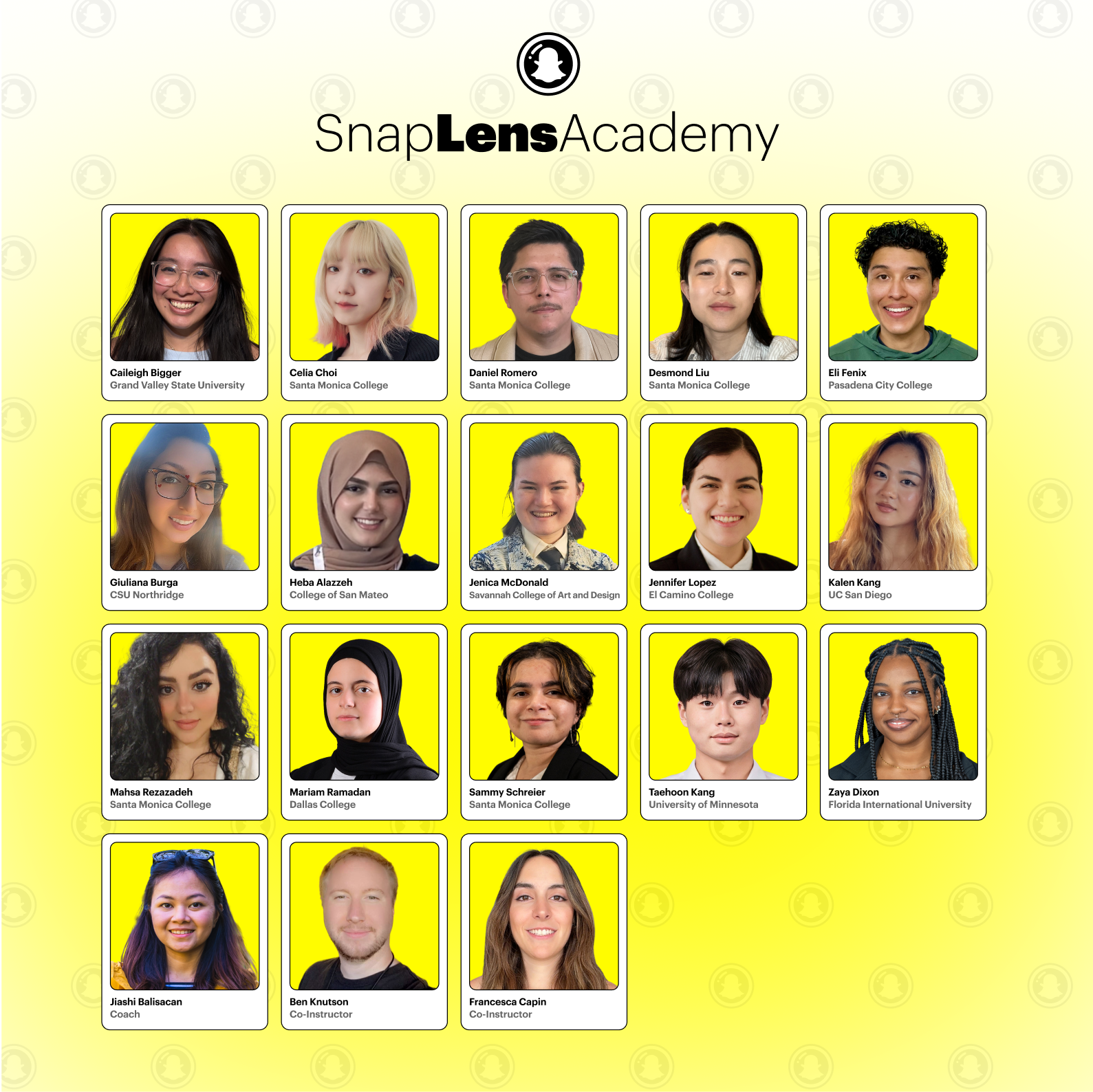
Snap Lens Academy scholars and instructors

Photo credit: Snap Lens Academy

Snap Academies program-wide numbers, across all four academies:

360+
scholars engaged across Snap Academies over eight years
88%
of scholars identify as Black, Indigenous, and People of Color
667
applications from 26 states in 2023
500+
Snap volunteers engaged in 2023
700+
hours of coaching and mentoring from Snap team members
250+
scholars graduated, some into internships and full-time roles at Snap

My Role

The learning scientist behind the instructors

I didn't work directly with scholars. My job was to make the people who teach them better at teaching. In 2023, I used AI transcription and analysis tools to process 100+ hours of SME instruction, far more content than I could have reviewed manually. That let me identify patterns across the entire curriculum and build learning plans grounded in what was actually happening in the classroom, not just what the syllabus said. I was one of the first people at Next Shift Learning to use AI in a systematic way to analyze instructional content at this scale.

This was the full professional learning cycle. I interviewed the subject matter experts to understand the domain. I learned enough about AR development and Lens Studio to speak the language. Then I coached two SMEs and a teaching assistant (a previous academy graduate) through eight weeks of the program, checking in weekly, facilitating the Slack group, holding people to deadlines, and helping them adjust to the real-time needs of their students.

I also crafted the rubrics for final projects. These weren't tests. Scholars built real AR lenses and presented them to Snap team members, and the rubrics needed to capture both technical proficiency and creative thinking. Beyond the Lens Academy, I contributed to Snap's self-paced AR curriculum for intermediate-to-advanced creators and the expansion of the AR Lens Challenge to the UK.

I worked on the 2023 cohort. Then they asked me back for 2025.


The Tension

By 2025, the technology had changed. So had the conversations.

In 2023, I used AI to teach myself about AR faster than I ever could have. By 2025, I had to help students figure out how to do the same thing. Between those two engagements, generative AI fundamentally changed how Snapchat approached AR technology and design. It changed the tools scholars were using for 3D modeling, texturing, and development. And it changed the conversations we needed to have in the classroom.

By April 2025, students were entering a field where the entire industry was already using AI tools. They couldn't ignore it. But they also couldn't skip the fundamentals. The challenge was teaching people how to balance both: where to lean on AI to accelerate their work, and where to still practice the core skills by hand so they actually understood what the tools were doing for them.

In 2023, AI allowed me to analyze more content than I ever could have on my own and teach myself an emerging technology faster than traditional methods would allow. By 2025, we couldn't just use AI behind the scenes. We had to teach students how to navigate it responsibly while still developing the foundational skills their careers depend on.


The Approach

An apprenticeship model for a field that's still being invented

The academy is structured as an apprenticeship. Scholars aren't sitting through lectures. They're learning by building, with working AR professionals guiding them through the same creative and technical decisions those professionals make every day. The final project is a cross-functional sprint where scholars prototype and pitch new products to Snap team members.

My contribution was making sure the learning design matched the ambition:

01

Audit and improve

Reviewed dozens of hours of previous instruction and used AI tools to analyze content at scale, identifying what was working, what wasn't landing, and where the learning design could be tightened.

02

Build frameworks

Created teaching frameworks that helped SMEs structure their expertise into learnable sequences, breaking complex AR concepts into the right chunks at the right time.

03

Experiential learning with standards

Helped instructors employ experiential education while holding students to clear expectations. We weren't just letting students experiment. We gave them precise challenges with rubrics, structured feedback, and rituals for improvement.

04

Coach instructors

Weekly check-ins with SMEs and TAs to apply learning theory in real time, adjusting to student needs, refining delivery, and helping technical experts become better teachers.


Why It Matters

Good teaching doesn't change. Everything else does.

AR development is a field where art and engineering overlap in ways that are genuinely new. The scholars in this program are learning to create experiences that blend the physical and digital world, and most of them are coming from backgrounds where nobody told them this career existed. Snap and Next Shift Learning have invested years and real resources into making this pipeline work.

The fundamentals of good teaching do not change, even as the platforms evolve. Our best chance for creating a learning environment where people can develop the skills that they will need for the future is by meeting learners where they are and creating a place where they can practice, not just absorb knowledge.

Need learning design that matches the ambition of your program?

See how I work